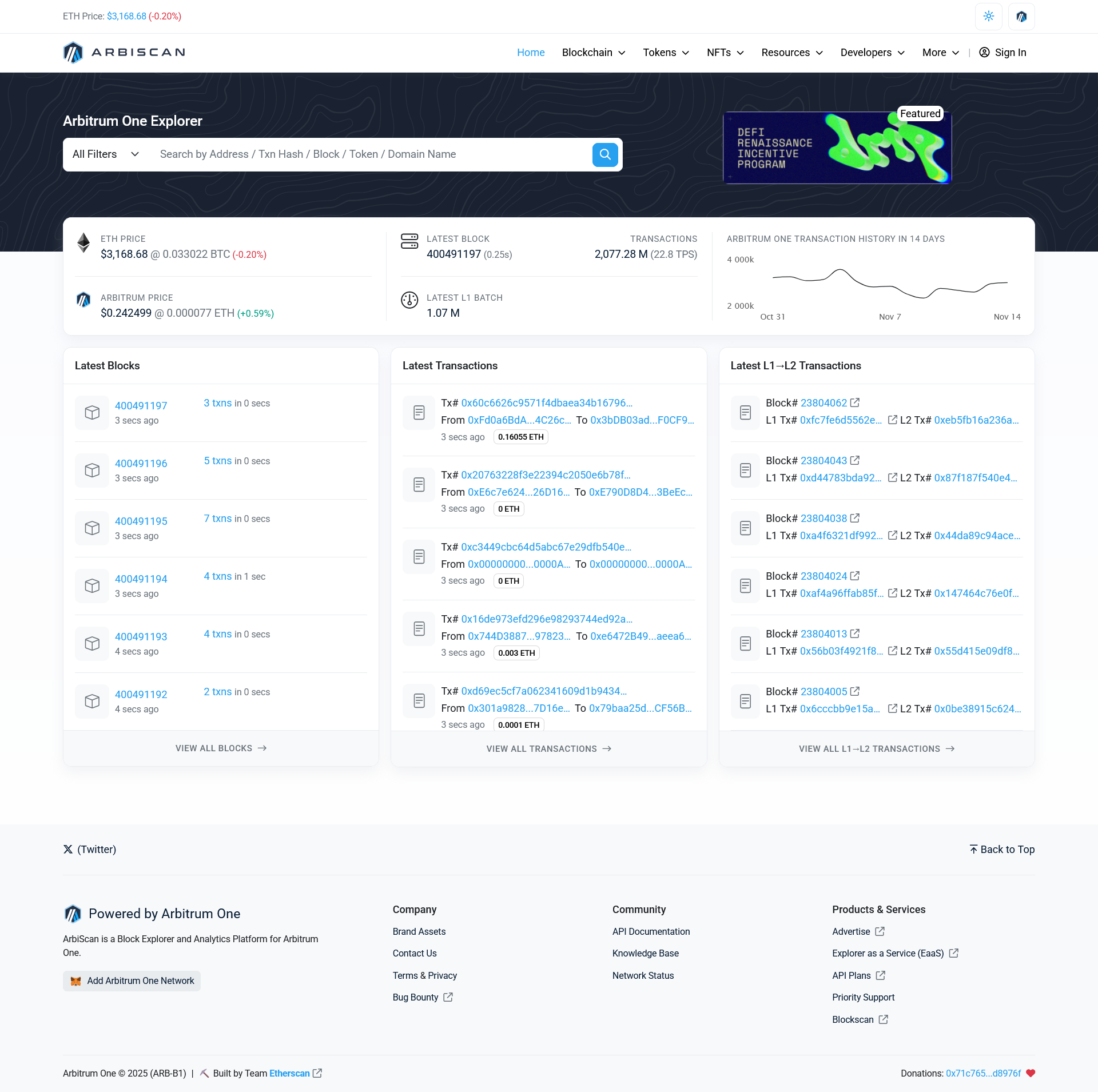
In the rapidly evolving world of blockchain and decentralized finance (DeFi), transparency and data accessibility are essential. Block explorers — tools that allow users to view and analyze on-chain data — are foundational to this transparency. Arbiscan is one such tool, but it holds special importance as the leading blockchain explorer for the Arbitrum network, a major Layer 2 scaling solution for Ethereum.
What Is Arbiscan ?
Arbiscan is a blockchain explorer and analytics platform designed exclusively for the Arbitrum ecosystem. It functions much like Etherscan does for the Ethereum mainnet: indexing on-chain data, making it easily searchable and readable for users, developers, and analysts. Arbiscan aggregates data from the Arbitrum network and presents it in a user-friendly interface so anyone can explore transactions, wallet activity, smart contracts, tokens, blocks, and more.
Arbitrum itself is an Ethereum Layer 2 solution built using Optimistic Rollup technology — which processes transactions off-chain and then settles them back on Ethereum to reduce fees and increase throughput — while retaining strong security guarantees.
In essence, Arbiscan is the “search engine” of the Arbitrum blockchain, enabling public access to every transaction and contract interaction that takes place on the network.
Why Block Explorers Matter
To understand the importance of Arbiscan, it helps to take a step back and consider the core principles of blockchain technology:
. Decentralization means no single entity controls the network.
. Transparency means all data — transactions, contracts, balances — are visible to anyone.
. Verifiability means proofs of transactions and balances can be independently checked.
Block explorers like Arbiscan are the tools that make these principles accessible to everyday users and professionals alike. They take the raw, cryptographically encoded blockchain data and turn it into something readable and actionable.
Without an explorer, users would have to rely on node-level software and directly parse complex protocol data — a task far beyond most people’s technical ability. Arbiscan fills that gap.
Core Features of Arbiscan
Arbiscan offers a comprehensive suite of features that serve multiple use cases, from everyday users checking their wallet balance to developers debugging smart contracts:
1. Transaction Tracking :-
Perhaps the most fundamental feature of Arbiscan is its ability to let users search for and inspect individual transactions on the Arbitrum network. By entering a transaction hash, users can view:
. Whether the transaction succeeded or failed
. The block in which it was included
. Sender and recipient addresses
. Gas used
. Amount of tokens transferred
This is incredibly useful for troubleshooting failed transactions, confirming payments, or verifying interactions with smart contracts.
2. Address and Wallet Insights :-
Arbiscan allows exploration of specific wallet addresses. For each address, users can see:
. Current token balances (including ERC-20 and ERC-721 tokens)
. A timeline of transaction history
. Interactions with any smart contracts
This feature is valuable for users tracking their own assets, researchers analyzing activity patterns, or auditors verifying token movements across the network.
3. Smart Contract Verification and Interaction :-
Developers can publish (verify) the source code of their smart contracts on Arbiscan. Verified contracts increase transparency because they allow users to view readable code instead of raw bytecode.
Once verified, Arbiscan also enables users to interact directly with smart contracts — for example, calling functions or querying contract state — all through the explorer interface.
Contract verification fosters trust in new DeFi projects, decentralized applications (dApps), and token launches by making the code public and available for audit.
4. Token and NFT Exploration :-
Arbiscan supports the exploration of:
. Tokens — Including standard fungible tokens (ERC-20)
. NFTs — Non-fungible tokens such as collectibles or in-game assets
This allows users to track token transfers, view token holder distributions, and verify creator information. On NFT tokens, users can see metadata details and ownership history — all on the Arbitrum network.
5. Real-Time Analytics :-
Beyond raw transaction details, Arbiscan provides analytics on network health, gas fees, block production, and contract deployment activity. Users can observe trends over time and identify spikes in activity — essential for developers and researchers tracking network performance.
Who Uses Arbiscan?
Arbiscan serves a broad audience:
Casual Crypto Users
Everyday users can check the status of transfers, confirm that DeFi trades have gone through, and verify wallet balances. This visibility empowers users to be confident in their on-chain actions.
Developers
For developers building on Arbitrum, Arbiscan is indispensable. It enables detailed debugging of smart contracts, verification of deployments, and monitoring of on-chain interactions. Researchers and engineers use its API data for analytics and building dashboards.
Traders and Analysts
In DeFi and NFT markets, traders often use Arbiscan to verify token contract authenticity and confirm liquidity pool transactions before executing trades. Analysts use on-chain data to identify trends, network adoption, and economic activity.
Arbiscan and Transparency
Blockchain ecosystems thrive on public verification. Arbiscan offers an open window into the Arbitrum network’s activity and empowers users to conduct due diligence on projects, smart contracts, and token movements.
This transparency also serves as an anti-fraud measure: suspicious contracts can be examined, token flows traced, and interactions identified — all by anyone with an internet connection. It’s a level of access that traditional financial systems don’t provide.
However, users should still exercise caution: Arbiscan provides the data, but it doesn’t interpret or validate the legitimacy of projects or transactions on its own. Token reputation labels and community-reported flags may exist, but users should still conduct thorough research before participating in unfamiliar DeFi protocols.
Limitations and Considerations
While Arbiscan is a powerful resource, there are some important caveats:
. Scope: Arbiscan only covers transactions and data occurring on the Arbitrum network. It doesn’t include activity on Ethereum mainnet or other Layer 2s unless specifically indexed.
. Complexity: New users unfamiliar with blockchain terminology may find the volume of data overwhelming.
. Interface Variations: Different sub-domains or clones of Arbiscan may exist online — some of which may be unreliable or scams — so always use the official site.
Conclusion
Arbiscan is more than just a blockchain explorer — it’s a window into the Arbitrum ecosystem. Whether you’re a casual user checking a transaction, a developer tracking contract state, or an analyst monitoring network health, Arbiscan delivers critical visibility into on-chain activity.
As Ethereum continues to scale via solutions like Arbitrum, tools like Arbiscan will remain indispensable. They uphold the core blockchain values of transparency and verifiability while offering accessible, real-time insights into decentralized systems.
In a space that evolves quickly, understanding the tools that power on-chain data exploration is crucial — and Arbiscan stands at the heart of that mission in the Arbitrum universe.

Offline Website Builder